Travelogue // Cinque Terre Photography

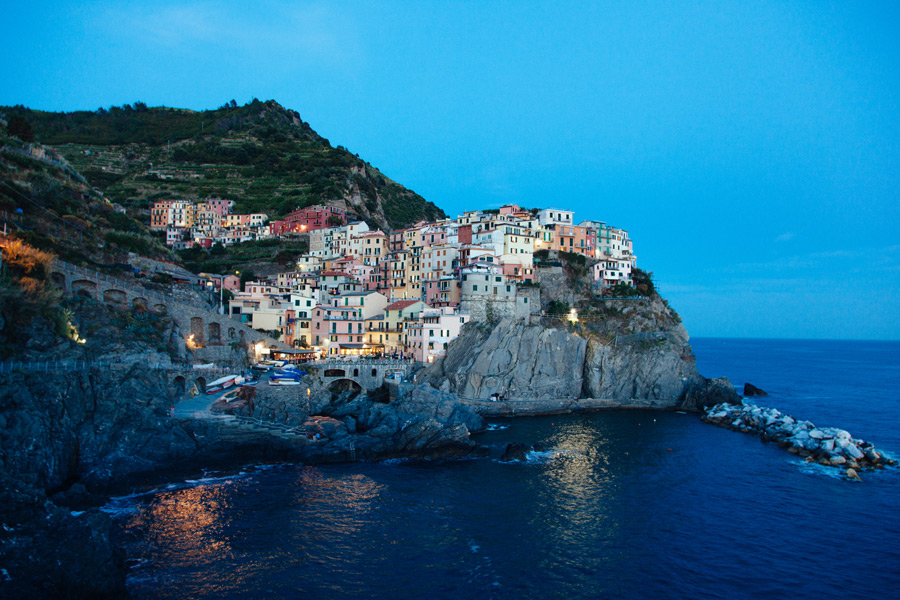
The Cinque Terre is a series of five villages perched on the Italian riviera coastline southeast of Genoa. The villages are, for the most part, only accessible by boat/ferry or the regional trains that run through them, connected from Pisa to Genoa. The first time I heard about them was reading a Rick Steve’s guide book on Italy. We visited in 2012 as part of our Italy trip. After spending a few days in the beautiful Tuscany countryside, we realized we missed seeing the ocean.

The train ride to CT was an adventure. The high speed trains in Italy and across Europe are fast and efficient. But the slower, local trains are so interesting. Perhaps because they provide a taste for slow travel and what feels like a more authentic experience, traveling almost like a local. We caught a train from Siena that was destined for La Spezia with a switch at Empoli. Once in La Spezia, we needed to catch a local train for CT. A map here if you are interested. On the Empoli to La Spezia leg, we stopped at Pisa station for a very long time. At first I didn’t notice because I was enthralled by my book of choice for that trip: Extremely Loud and Incredibly Close. But then Mike pointed out we’d been sitting there for 20 minutes. There hadn’t been any announcements, not even in Italian. No train conductors appeared to tell us what was going on. A few minutes after, some of the locals started to get off. I asked one person if he knew what was happening, and he said no one knows. Then I saw across the platform, there was a train coming into the station in 5 minutes that was headed to La Spezia. I told Mike we should just get off our train and hop on that one since our ticket brings us to the same destination. When the new train arrived, our original train was still sitting there. That experience reminded me a lot of taking the trains in China as a child. The disorganized nature and lack of information.

So, a note about taking regional trains in Italy, if your train stops for a long time for no reason, don’t panic! The CT train from La Spezia spent much of its first 5 minutes passing through mountain tunnels, then suddenly, we are out of it, and you just see emerald green and blue waters of the Ligurian sea, it was a sight that caused the whole train to go “wow!”

Favourite things about the Cinque Terre:

– The natural stunning scenery

– You get a bit of both: mountains & ocean

– Hiking between the villages: though when were there in 2012, a couple of them were still closed as a result of the landslides that happened in fall of 2011.

– The amazing seafood in the area

– Amazing gelato! (although really, gelato is amazing everywhere in Italy I’m sure)

– The indescribable old-world charm of the villages. You know the saying about a slower paced life in more remote areas of the world, and here, even though it’s not that remote, you feel it. Even as travellers, you feel more relaxed

– How despite the increasing crowds visiting the region, it still retains its charm and authenticity. At night, when the day trippers have gone, the streets are filled with mostly locals (lots of Nonna’s) and it feels like time has not touched this place much in the past fifty years.

There is a tunnel on the walkway from Riomaggiore to Manarola (affectionately dubbed as Via dell’Amore, or Lover’s Walk), and it is filled with graffiti and writings.

Train station with a view :)

Vernazza. It’s the favourite village of a lot of people. We bought pizza from a pizza place just up the street from the harbour.

We sat down by the seawall, in the shade, ate delicious pizza (probably one of the best I’ve ever had);

drank Italian lemon soda (my fave!);

watched the comings and goings at the harbour and in the square;

And then sat on the rocks and watched the sun dip below the next town and the curve in the landscape.

It was one of my favourite days from that trip.

(Sorry, no photo of the pizza, you’ll just have to take my word for it).

This last photo makes me think of Old Man and the Sea.

Except it’s more like Old Men here…although they were kind of far, so not sure if they are even old! :D

Where to stay:

Aria di Mare in Manarola – lovely place, definitely rooms with a view

Where to eat:

Trattoria dal Billy (Manarola) – awesome view, amazing seafood!

Il Porticciolo (Manarola) – yummy seafood pasta

Gelato (anywhere!)

Travelogue // Tuscany

This is part 2 in my travelogue series on Italy. The first part on the Amalfi coast is here. :)

Mike and I went to Florence on our 2010 trip but didn’t really get to explore the Tuscany country side. Florence was beautiful, not to mention the world class Uffizi gallery and the Academia Gallery where Michelangelo’s David is. Better go early for both of these otherwise the lineups are unbelievably long. You can also buy tickets ahead of time at a smaller tourist attraction for both of them and skip the ticket line. Oh there are two lines: the ticket line, and the security line. Yea, have fun with that :) If I sound a little bitter, it’s only because we got yelled at by one of the gallery workers at the Uffizi, for both sitting on a bench (which mind you was perfectly capable of seating 2, if not 3 people). And no, there wasn’t a sign saying you can’t sit on it. I think she was just having a bad day. And yes, 4 years later I still remember that incident. What can I say, I’m a Scorpio, I hold grudges. ;)

To be honest, I thought the Academia wasn’t that exciting besides David, if you want to see other amazing works by Michelangelo and Bernini, don’t miss the Borghese Gallery in Rome. That was my favourite museum in Italy.

I think two of my favourite things in Italy besides the beautiful scenery and culture were gelato and focaccia (both food related of course haha). Gelato is pretty self explanatory. Focaccia is too I think. But they make it a bit differently in different parts of Italy. The Tuscan variety tends to be thinner and simpler, usually just seasoned with a bit of olive oil, salt and a bit of herbs. It’s so delicious. When we were in Tuscany in 2012, I think I ate the bread for breakfast, lunch and dinner. :D Gelato was pretty much a twice-a-day exercise; not eaten right after focaccia, that’s just weird.

Our 2012 visit brought us to Siena, then onto the Tuscany countryside from there. We rented a little Smart Car for 3 days. We had to get an automatic since neither of us could drive manual at the time. But the car wasn’t a true automatic and man it was fun getting up those little hills. Two tips for driving in the Italian countryside:

1. Unless you drive like an Italian, better get used to the impatient gesturing of the driver behind you, the honking and eventual passing. I don’t know what it is, but these friendly people turn into a completely different species when they get behind the wheel.

2. Get a detailed road map before you drive off! Ask me how many times we drove around Siena while trying to figure out how to get out of the city without a map. I think it might have been 3.

This is Siena’s Duomo. They started building it after Florence built theirs. The competition was fierce!

It’s not as grand as the one in Florence because they never finished theirs in Siena when the Black Death hit in 1348.

I have a really funny memory of this place. I was in line for tickets and after getting two tickets, I walked towards Mike,

looked back at the ticket booth, and burst out laughing. Mike asked me what was funny.

I said I just realized why I felt so strange getting the tickets:

the ticket booth was ridiculously low, I had to bend down and crane my neck to

speak to the ticket seller. Everyone else was doing the same thing.

I should have taken a photo of this ticket booth, but I was too caught up in that moment.

here it is: Il Campo. Europe’s most beautiful square. Well, minus the construction crane.

Wooden shutters are the best, no?

The next 3 photos were taken from the old city walls, which is a must visit at dusk.

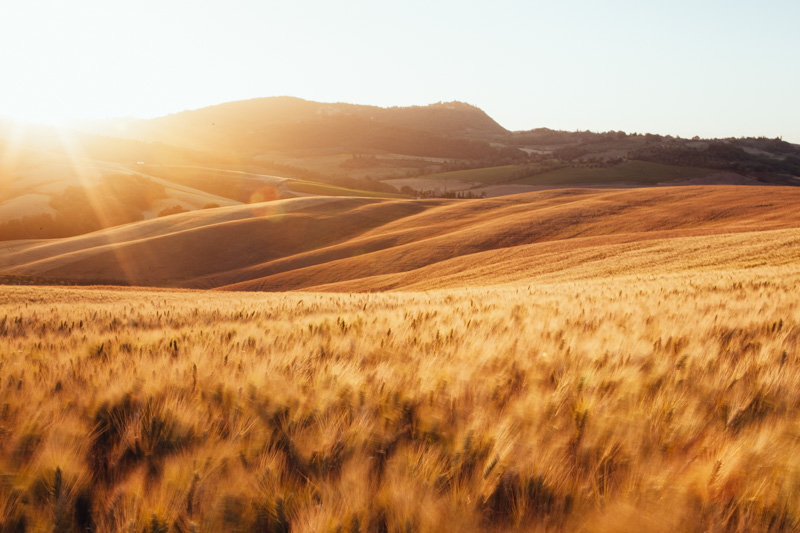
The rolling hills of Tuscany. It really is as pretty as the postcards.

a vintage Fiat! They are so cute.

Wheat fields always remind me of that scene in The Gladiator where Maximus is walking through one, his hand sailing through them.

Me reading our Toscana map: it was bigger than me when completely unfolded :D

It’s so fun going through old photos and finding ones you’d forgotten about.

Next up in the Italian travelogues: the charming Cinque Terre.

Travelogue // Amalfi Coast, Italy

The first time I traveled to Italy was in 2010. M and I visited Rome, Amalfi Coast, Florence and Venice in our short 12-day trip. Italy was always high on my “must visit” list ever since I was little. The country just seemed so romantic. And their language sounds so beautiful. When I read Eat Pray Love by Elizabeth Gilbert, I read that the Italian language had a very poetic and literary origin. I will try to be brief here and try to paraphrase from the book as much as possible. Italy for centuries had been independent city-states often at war with each other, and alternately dominated by other European powers. It did not become unified until 1861. Though Latin was still used, it was mainly used by the scholars and educated men in a written format. A derivative of Latin called Vulgar Latin (a colloquial form spoken by common people) was the predecessor to Romance languages such as French, Spanish, and Portuguese. In every other country, the resulting modern day national language was a result of the dominating city, which determined the language of the whole country. This was not the case in Italy. Like its neighbours, many regional dialects existed across the country; dialects so different that a Florentine scholar could not communicate with a Venetian merchant. Then in the 16th century, some Italian intellectuals got together and decided that it was absurd they didn’t have a common language to be called their own. Then they did something quite dramatic, which was they handpicked the dialect that was the most beautiful, which became known as Italian. The basis for that beautiful dialect? It was based on the Florentine language in which Dante had used to write his Divine Comedy in the 14th century. Dante actually thought Latin to be a “corrupt, elitist” language and had turn to the street where Florentine was spoken by the residents of his city.

For a while I somewhat doubted her account because I thought it was unbelievable for a language to be “picked” that way. Then I realized this was in a published book, which means she must have done her research and wouldn’t have published content that was inaccurate (duh). I have since confirmed this with Wikipedia (I know, very scholarly of me). As Elizabeth Gilbert pointed out, for a group of Italian intellectuals to get together and pick a dialect that was the most beautiful to be their official language is equivalent of a bunch of Oxford scholars to get together in early 19th century and decide that from now on we would all speak pure Shakespeare. I actually think that would be kind of amazing. I love the way Shakespearean English sounds.

So yes, a beautiful country with a beautiful language. We returned again in 2012 for part of our honeymoon. Because I have too many photos, I decided to split them into separate posts. Here are some photos from the Amalfi coast.

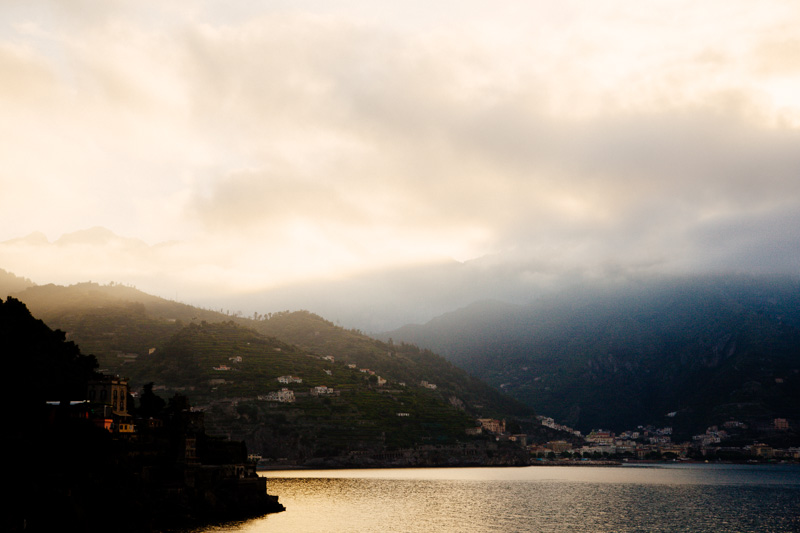
The Amalfi coast is probably one of the most well known regions in Italy, and for a reason. It’s stunningly beautiful. The towns that perch right along the cliffs with an azure Tyrrhenian sea at their doorsteps practically. Then there’s the hairpin turns of the coastal drive. For both of our visits, we started in the town of Sorrento, which is where the train line ended. But before that, if you are coming from the north, you will most likely be taking a high speed train from Rome to Naples. From Naples, you’ll catch a local commuter train called Circumvesuviana. The experience on that train is very authentic. Though if you do a search on travel forums, you’ll likely find some negative complaints from travellers, mainly about robbery or thieves. Our experience was as long as you keep a low profile (the stereotypical loud, naive American traveler comes to mind…), be alert of your surroundings and don’t wear flashy jewellery, you will be fine. My favourite memory traveling on that train was exiting the Naples suburbs and the train traversing through lemon and orange groves on one side; so close that the tree branches rattled against the windows as the train speeds along. And on the other side, the view to the Bay of Naples coming in and out of sight through the seaside towns. This is why I love train travel, you don’t have to worry about how to get to your destination once you step on the train, you can just enjoy the journey.

Sorrento is famous for its lemon products. Their lemons are very big.

Sorrento is the gateway to the Amalfi coast. From there, you can either hire your own car and enjoy the coastal towns or use the efficient public buses to connect your routes.

The first option gives you more freedom, though the drive can be a bit intimidating for non-Italian drivers.

The second option is a bit more restricted but cheaper. I almost forgot, you can also take a ferry between certain villages in the summer.

You can also take a short ferry ride (30 to 45 minutes) from Sorrento to the island of Capri.

Cable car ride (or more like cable chair lift) to and from Monte Solaro, the highest point on the island.

That was the most intense cable car ride I’ve ever had.

The only thing that stopped you from falling off was a thin iron bar.

Granted the ride was very smooth and the scenery was too beautiful to be afraid anyway.

Lots of tourists and boats jostling to get into the Blue Grotto. While we thought the island was beautiful, we also found it to be too touristy.

Bus ride photo of the coast.

A big part of why we decided to return to the Amalfi coast for our honeymoon was to hike The Path of the Gods.

Or Sentiero degli Dei in Italian. I don’t speak Italian but try to pronounce the words and tell me they don’t sound beautiful.

This was the absolute highlight of our trip. Besides a thrilling coastal drive (if that’s your thing),

this is in my humble opinion the best way to enjoy the coast.

And, it’s free!

You can find more info on the hike here, or read reviews of the hike here.

The views of the coast unfolding below was just breathtaking.

We were so high up I felt like I could touch the clouds if I reached up.

We started the hike in the little village of Bomerano, on the hill above the village of Praiano. The hike took us about 3 hours.

Most people stop at the little hamlet of Nocelle, high above Positano.

From there, we were told there’s a bus that can take us to Positano or take a series of steps.

We wandered around town but couldn’t find this bus stop. So we decided to take the 1,600 steps down to Positano.

I thought going uphill is bad, but nothing compared to the downward hike. It was tough on our knees and calf muscles.

One note here is if you do this hike any time from June to mid September, start as early as you can.

There are scarcely any shady patches on the hike, so it gets very hot by mid-day.

From Positano, we took a ferry back to Amalfi.

For our second visit, We stayed at Villa San Michele, which was just below the village of Ravello.

The hotel was built into the side of the cliff, right into the rocks. So each room has a sea view.

the beautiful Villa Cimbrone garden.

“My soul is full of longing

for the secret of the sea

and the heart of the great ocean

sends a thrilling pulse through me”

– Henry Wadsworth Longfellow

Until next time, ciao ciao!

Exit mobile version