I love stories. My perfect Sunday afternoon would be sitting somewhere in the sun, a cup of tea, and a good book in hand. Here I share some of the stories from my life and loves.
This is part 2 in my travelogue series on Italy. The first part on the Amalfi coast is here. :)
Mike and I went to Florence on our 2010 trip but didn’t really get to explore the Tuscany country side. Florence was beautiful, not to mention the world class Uffizi gallery and the Academia Gallery where Michelangelo’s David is. Better go early for both of these otherwise the lineups are unbelievably long. You can also buy tickets ahead of time at a smaller tourist attraction for both of them and skip the ticket line. Oh there are two lines: the ticket line, and the security line. Yea, have fun with that :) If I sound a little bitter, it’s only because we got yelled at by one of the gallery workers at the Uffizi, for both sitting on a bench (which mind you was perfectly capable of seating 2, if not 3 people). And no, there wasn’t a sign saying you can’t sit on it. I think she was just having a bad day. And yes, 4 years later I still remember that incident. What can I say, I’m a Scorpio, I hold grudges. ;)
To be honest, I thought the Academia wasn’t that exciting besides David, if you want to see other amazing works by Michelangelo and Bernini, don’t miss the Borghese Gallery in Rome. That was my favourite museum in Italy.
I think two of my favourite things in Italy besides the beautiful scenery and culture were gelato and focaccia (both food related of course haha). Gelato is pretty self explanatory. Focaccia is too I think. But they make it a bit differently in different parts of Italy. The Tuscan variety tends to be thinner and simpler, usually just seasoned with a bit of olive oil, salt and a bit of herbs. It’s so delicious. When we were in Tuscany in 2012, I think I ate the bread for breakfast, lunch and dinner. :D Gelato was pretty much a twice-a-day exercise; not eaten right after focaccia, that’s just weird.
Our 2012 visit brought us to Siena, then onto the Tuscany countryside from there. We rented a little Smart Car for 3 days. We had to get an automatic since neither of us could drive manual at the time. But the car wasn’t a true automatic and man it was fun getting up those little hills. Two tips for driving in the Italian countryside:
1. Unless you drive like an Italian, better get used to the impatient gesturing of the driver behind you, the honking and eventual passing. I don’t know what it is, but these friendly people turn into a completely different species when they get behind the wheel.
2. Get a detailed road map before you drive off! Ask me how many times we drove around Siena while trying to figure out how to get out of the city without a map. I think it might have been 3.
This is Siena’s Duomo. They started building it after Florence built theirs. The competition was fierce!
It’s not as grand as the one in Florence because they never finished theirs in Siena when the Black Death hit in 1348.
I have a really funny memory of this place. I was in line for tickets and after getting two tickets, I walked towards Mike,
looked back at the ticket booth, and burst out laughing. Mike asked me what was funny.
I said I just realized why I felt so strange getting the tickets:
the ticket booth was ridiculously low, I had to bend down and crane my neck to
speak to the ticket seller. Everyone else was doing the same thing.
I should have taken a photo of this ticket booth, but I was too caught up in that moment.
here it is: Il Campo. Europe’s most beautiful square. Well, minus the construction crane.
Wooden shutters are the best, no?
The next 3 photos were taken from the old city walls, which is a must visit at dusk.
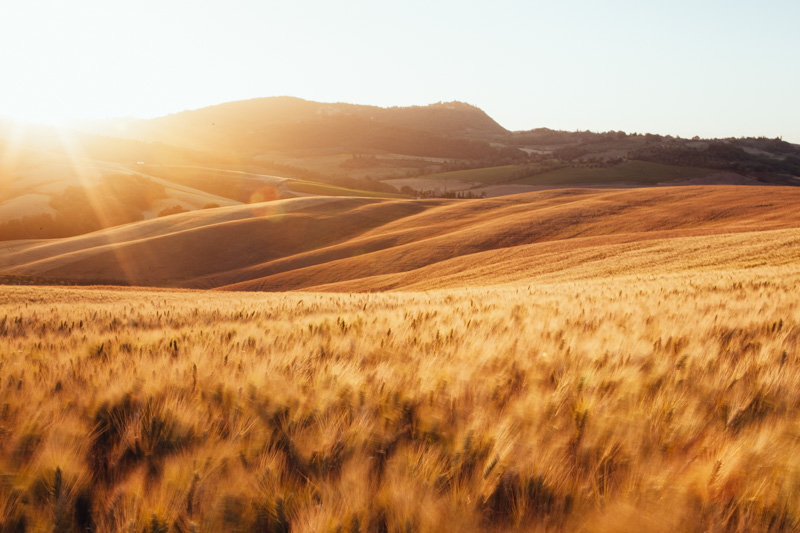
The rolling hills of Tuscany. It really is as pretty as the postcards.
a vintage Fiat! They are so cute.
Wheat fields always remind me of that scene in The Gladiator where Maximus is walking through one, his hand sailing through them.
Me reading our Toscana map: it was bigger than me when completely unfolded :D
It’s so fun going through old photos and finding ones you’d forgotten about.
Next up in the Italian travelogues: the charming Cinque Terre.
Whenever I travel (except if we are going to a resort), I always bring just one backpack and another smaller day pack such as a messenger bag.
But why travel with a backpack instead of a rolling suitcase with wheels? Wouldn’t it be easier to roll your luggage than carry a 20 lb pack (mine at its heaviest) on your back? Personally, I like the freedom a backpack allows me. While it can seem easier to roll your suitcase at times, traveling with one just doesn’t suit my travel style as an independent traveler. With everything I need in just two bags that can both go on my shoulders, my hands are free and I don’t feel tied down by the things I have. There have been countless times where I was very glad I had a backpack: going up and down stairs where there is no escalator or elevator (such as smaller hotels in Europe and elsewhere), walking to hotel or train station on cobblestone streets, walking in crowded places such as train or metro stations, traveling on a crowded local bus etc.
M and I enjoy traveling independently, so no organized tours (not to say there is anything wrong with tours). Having just a backpack and a day pack each provide us with the ability to move faster and be more nimble. Basically we travel Amazing Race style :) minus the fanny pack. There is something liberating about having everything you need on your back. You are not weighed down by your things; they don’t own you, you own them. And it’s amazing to know you really don’t need all that much stuff to survive or live comfortably.
Packing light for travel is easier said than done though. It’s even harder as a photographer when you want to bring every lens and camera body you have. In the past, I always ended up with more things than I actually needed or used. Which meant I ended up with a pretty heavy backpack, usually heavier than M’s haha. Although I’m by no means a well seasoned traveler (have only been to 14 countries to date), I’ve finally come up with my own system for packing lightly through trial and error.
Since I’m going to Stockholm and Iceland in a few days, I’m using the items I’ve packed for this trip as an example.
Here’s a breakdown of what goes into my backpack:
1. The backpack itself: a 50 L Gregory Jade backpack that I’ve had for a few years. I think I spent about $200 but it’s important to get a good quality backpack because it will be well built, durable and provide better support for your back and hips. I think I can easily get another 5 years out of this bag even after all the rough handling by airport personnel :D
2. Soft Lug travel pillow for those redeye flights and long distance train travels. Speaking of travel pillows, have you seen this new J pillow? It seems way more comfortable but a bit bulkier. Or this?? I don’t think I’d ever use this. ha.
3. Toiletry bag with all the essentials: personal hygiene items including face cleanser, moisturizer, tooth brush, tooth paste, deodorant, makeup, mostly all travel sized or under 100ml; face cloth; medications including Gravol (since I get motion sickness), cold/flu meds, tylenol or similar, bandaids, tums; tissues; cotton pads
4. 2 sweaters. The one on top is my Icelandic wool sweater which is the warmest thing I’ve ever worn! It’s really thick so I wear it on travel days. If I’m traveling to warmer destinations, I only bring 2 thin cardigans.
5. Light weight & waterproof rain jacket. I pretty much bring this with me on every trip now. It’s super light weight plus it has a hood so saves me having to bring an umbrella. Once while in Scotland, M and I (M has the same jacket but the male version in blue) walked in the rain for over an hour to our B&B after a hike . When we got back, we were still dry inside. Since I’m traveling in early March, it will still be fairly cold so I’m bringing a hat and mittens as well (not pictured).
6. 4 shirts/tops: 1 short sleeved t shirt, 2 long sleeved shirts as base layers and a denim shirt to layer with. If traveling to warmer destinations, I bring 4 short sleeved t shirts and 1 or 2 long sleeved ones plus a dressier top.
7. 1 pair of cotton pants, 1 pair of jeans (which I will wear on travel days) + wool tights to wear as base layer if really cold. If traveling to warmer destinations, two pairs of shorts + 1 pair of cotton pants.
8. 3 pairs of socks; usually I only bring 2 pairs but since it’ll still be cold I’m bringing my merino wool Icebreaker socks. My friend Kristen introduced me to these, pretty much warmest socks around.
9. A bathing suit. I might not use these but in case I visit the Blue Lagoon or a hot spring.
10. Tripod for those beautiful night photos. This is probably one of the heavier things in my bag, I might get a lighter version next year.
11. Hiking shoes. These are a bit bulky and not so stylish but I’m past the point in my life where I sacrifice comfort for style too much. ;) They are sturdy, warm, water resistant and really comfortable. If traveling to warmer places, I add a pair of Birkenstocks as well.
Not pictured here: mittens, a scarf and under garments
Additional things: 3 – 4 dresses + a skirt and a straw hat for warmer climate travels. Oh and sunscreen!
I find with this list, no matter if I’m traveling for 1.5 weeks or 5 weeks, or indeed 2 months, they are more than enough. The key is to pack clothes that will mix and match well and are versatile. Wear bulkier items on travel days if possible. Beyond that, the trick is to wash your clothes while traveling. Laundromats can be found almost everywhere.
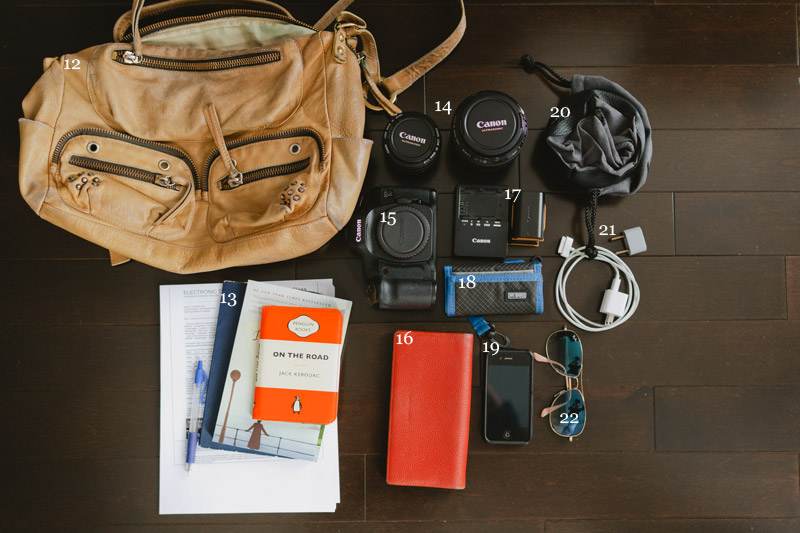
Things that go into my day pack:
12. The bag itself; a leather messenger bag I’ve had for years. It’s roomy, sturdy and has additional pockets for smaller items.
13. Travel documents, a pen, a Moleskine journal, my passport and always, a book. I usually try to pick one that’s not as thick, and no hardcovers!
14. Lenses; not pictured here is my 35mm f1.4 lens since I was using it :)
15. Canon 5D Mark iii camera body (pictured here is the 5D instead since I was using the Mark iii)
16. Wallet with credit cards, travel insurance details, bank cards + cash
17. Battery charger + extra battery
18. Memory cards
19. iPhone for emails & Instagram of course
20. Lens pouches to protect the lenses
21. iPhone charging cord + the correct plug converter
22. Sunglasses
This list is quite a bit longer if I’m traveling for work for obvious reasons. Add another camera body, lens, flash, and more batteries. Besides my camera gear, I’m pretty low tech, no iPads or laptop…for now anyway. I might need to get a laptop for on the road editing and such if I travel for work more.
Additional things: sometimes a guidebook. But I try to use electronic versions these days. Lonely Planet is great for these.
Here’s what the final packed bags look like! I might actually be able to bring both as carry on items. The backpack being the carry on and the messenger bag is my personal item. The biggest advantage of not having to check your bag is not have to worry about the airline losing it! And then once you get to your destination you can hit the ground running and not have to wait at the luggage carousel.
Final tip: start early! I’m bad at this but M always plans an hour for packing at least a week before we leave. You don’t have to put everything into your bag/suitcase, but at least gather things and put them in a separate area. Plan your outfits strategically while you do this (I know this can be hard for the ladies), and then edit, edit, edit!
The first time I traveled to Italy was in 2010. M and I visited Rome, Amalfi Coast, Florence and Venice in our short 12-day trip. Italy was always high on my “must visit” list ever since I was little. The country just seemed so romantic. And their language sounds so beautiful. When I read Eat Pray Love by Elizabeth Gilbert, I read that the Italian language had a very poetic and literary origin. I will try to be brief here and try to paraphrase from the book as much as possible. Italy for centuries had been independent city-states often at war with each other, and alternately dominated by other European powers. It did not become unified until 1861. Though Latin was still used, it was mainly used by the scholars and educated men in a written format. A derivative of Latin called Vulgar Latin (a colloquial form spoken by common people) was the predecessor to Romance languages such as French, Spanish, and Portuguese. In every other country, the resulting modern day national language was a result of the dominating city, which determined the language of the whole country. This was not the case in Italy. Like its neighbours, many regional dialects existed across the country; dialects so different that a Florentine scholar could not communicate with a Venetian merchant. Then in the 16th century, some Italian intellectuals got together and decided that it was absurd they didn’t have a common language to be called their own. Then they did something quite dramatic, which was they handpicked the dialect that was the most beautiful, which became known as Italian. The basis for that beautiful dialect? It was based on the Florentine language in which Dante had used to write his Divine Comedy in the 14th century. Dante actually thought Latin to be a “corrupt, elitist” language and had turn to the street where Florentine was spoken by the residents of his city.
For a while I somewhat doubted her account because I thought it was unbelievable for a language to be “picked” that way. Then I realized this was in a published book, which means she must have done her research and wouldn’t have published content that was inaccurate (duh). I have since confirmed this with Wikipedia (I know, very scholarly of me). As Elizabeth Gilbert pointed out, for a group of Italian intellectuals to get together and pick a dialect that was the most beautiful to be their official language is equivalent of a bunch of Oxford scholars to get together in early 19th century and decide that from now on we would all speak pure Shakespeare. I actually think that would be kind of amazing. I love the way Shakespearean English sounds.
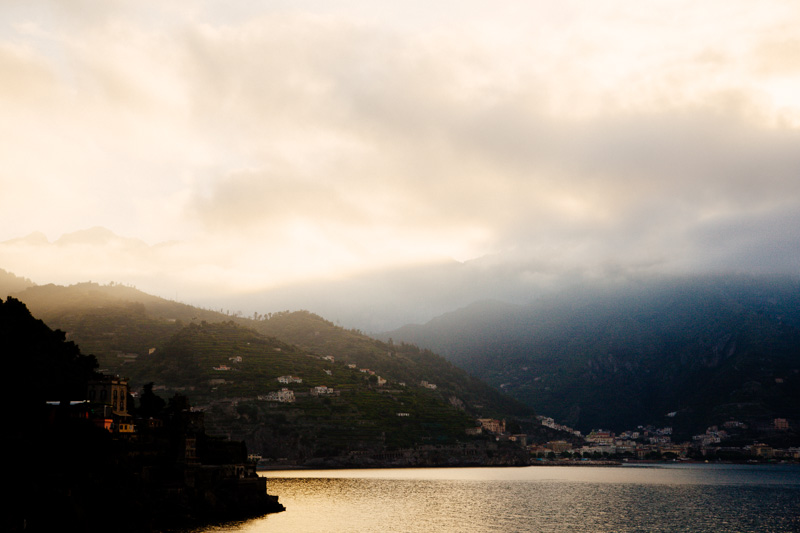
So yes, a beautiful country with a beautiful language. We returned again in 2012 for part of our honeymoon. Because I have too many photos, I decided to split them into separate posts. Here are some photos from the Amalfi coast.
The Amalfi coast is probably one of the most well known regions in Italy, and for a reason. It’s stunningly beautiful. The towns that perch right along the cliffs with an azure Tyrrhenian sea at their doorsteps practically. Then there’s the hairpin turns of the coastal drive. For both of our visits, we started in the town of Sorrento, which is where the train line ended. But before that, if you are coming from the north, you will most likely be taking a high speed train from Rome to Naples. From Naples, you’ll catch a local commuter train called Circumvesuviana. The experience on that train is very authentic. Though if you do a search on travel forums, you’ll likely find some negative complaints from travellers, mainly about robbery or thieves. Our experience was as long as you keep a low profile (the stereotypical loud, naive American traveler comes to mind…), be alert of your surroundings and don’t wear flashy jewellery, you will be fine. My favourite memory traveling on that train was exiting the Naples suburbs and the train traversing through lemon and orange groves on one side; so close that the tree branches rattled against the windows as the train speeds along. And on the other side, the view to the Bay of Naples coming in and out of sight through the seaside towns. This is why I love train travel, you don’t have to worry about how to get to your destination once you step on the train, you can just enjoy the journey.
Sorrento is famous for its lemon products. Their lemons are very big.
Sorrento is the gateway to the Amalfi coast. From there, you can either hire your own car and enjoy the coastal towns or use the efficient public buses to connect your routes.
The first option gives you more freedom, though the drive can be a bit intimidating for non-Italian drivers.
The second option is a bit more restricted but cheaper. I almost forgot, you can also take a ferry between certain villages in the summer.
You can also take a short ferry ride (30 to 45 minutes) from Sorrento to the island of Capri.
Cable car ride (or more like cable chair lift) to and from Monte Solaro, the highest point on the island.
That was the most intense cable car ride I’ve ever had.
The only thing that stopped you from falling off was a thin iron bar.
Granted the ride was very smooth and the scenery was too beautiful to be afraid anyway.
Lots of tourists and boats jostling to get into the Blue Grotto. While we thought the island was beautiful, we also found it to be too touristy.
Bus ride photo of the coast.
A big part of why we decided to return to the Amalfi coast for our honeymoon was to hike The Path of the Gods.
Or Sentiero degli Dei in Italian. I don’t speak Italian but try to pronounce the words and tell me they don’t sound beautiful.
This was the absolute highlight of our trip. Besides a thrilling coastal drive (if that’s your thing),
this is in my humble opinion the best way to enjoy the coast.
And, it’s free!
You can find more info on the hike here, or read reviews of the hike here.
The views of the coast unfolding below was just breathtaking.
We were so high up I felt like I could touch the clouds if I reached up.
We started the hike in the little village of Bomerano, on the hill above the village of Praiano. The hike took us about 3 hours.
Most people stop at the little hamlet of Nocelle, high above Positano.
From there, we were told there’s a bus that can take us to Positano or take a series of steps.
We wandered around town but couldn’t find this bus stop. So we decided to take the 1,600 steps down to Positano.
I thought going uphill is bad, but nothing compared to the downward hike. It was tough on our knees and calf muscles.
One note here is if you do this hike any time from June to mid September, start as early as you can.
There are scarcely any shady patches on the hike, so it gets very hot by mid-day.
From Positano, we took a ferry back to Amalfi.
For our second visit, We stayed at Villa San Michele, which was just below the village of Ravello.
The hotel was built into the side of the cliff, right into the rocks. So each room has a sea view.
Paris. Is there any other city in the world that can conjure up such feelings of romance & love? Perhaps that is subjective, but for me there is no other (except maybe Venice). This is the post where I tell you how much I love this city and share why I love it so much. This is also the post where you’ll have to excuse me for shamelessly stuffing in some terms like “paris wedding photographer” or ” destination wedding photographer paris”. Or “paris elopement photographer”. :) I’m not too picky. If you are planning to run away to Paris to get married and happen to read this, well, please email me! It would be a dream come true to photograph a wedding in Paris.
The first time I went to Paris was in June of 2009, after graduating from university. It was everything I thought it would be and more: the pastries, the chocolates (& macarons), the architecture, the history, the museums, the eiffel tower. It’s hard to imagine that when the eiffel tower was first constructed, the Parisians hated it and dubbed it “the giant asparagus”. Little did they know that it would become the iconic image of their beloved city. We stayed 4 nights on that first visit; it was not enough. I’ve since returned twice, and still it’s not enough. For those of us who love the city, we each have our own reasons. I’ve thought about this a lot, and it was hard to put into words but here are the two main reasons:
1. It is a city that’s steeped in history; every street corner, every bridge, every cobblestone. Having stood on the banks of the Seine for thousands of years, the city is practically alive with all the stories that took place across the years. But what about the Parisians? This is usually the question I get whenever I talk about my love of Paris. Well, what about them? Sure there are some who are true to the stereotype. But I don’t think they are any more rude compared to people of other major cities. I think they are just indifferent to outsiders. And anyway I can do without the people. I’m sorry if this offends anyone, but for me Paris is not extra magical because of its people (the way Iceland is extra magical because of its people), Paris is magical in and of itself.
2. It is a city that is proud of its past and will not just forget it. They proudly & happily live amongst it. Because of that, and because of their philosophy of “working to live” instead of “living to work”, the city is very much for living. It’s built for you to walk, to go outside and connect, to enjoy your surrounding, or to pause and sit on many of the benches along its boulevards and the Seine. Though on my second visit I learned that Paris was not always this beautiful. The wide, treelined boulevards and typical Parisian houses (Haussmann style) with balconies on the 2nd and 5th level were the result of extensive renovations commissioned by Napoléon III in the mid to late 1800’s. The more modern part of the city is kept outside of the city centre. You won’t find any high rises within the city centre. And I hope that will never change. Most other great European cities are not like this. Their past is almost completely mixed in with their present. Not that there is anything wrong with that in and of itself. But there’s something wonderful about being able to experience the city the way you would have hundreds of years ago (for the most part). I think the only other cities that come close to this (that I’ve been to) are Amsterdam with its centuries old canal houses and Venice. But the latter is slowly becoming like an amusement park with fewer and fewer locals who can afford to live in the city. The saying is that at any given point in time, there are more tourists in Venice than there are locals.
So here are some photos from the three visits I’m lucky to have so far, along with some of my favourite things.
P.S. some of these were taken more than 3 years ago, so don’t judge me too harshly ok? ;)
The cobblestones in this courtyard (bottom left) are among some of the oldest in the city.
It was breathtaking. I would go back any day just to lay my eyes upon them again.
Can’t talk about musées in Paris without talking about the Louvre. I’ve been to the MET in New York, some of the best in London and across Italy.
There is nothing like the Louvre.
You can spend days, weeks here and never see it all. There’s always a new hall to explore. The building complex alone is a museum.
If you visit the museum, be sure to stick around long enough to watch the awe inspiring sunset from the courtyards.
That was one of my absolute favourites from our first visit, and I go back every time I return to Paris.
Tip: admission is free first Sunday of each month; and free Fridays after 6pm if you are under 26. Also free for EU citizens under 26
Notre Dame. No matter how many times I come here, it still takes my breath away upon entrance.
Paris rooftops.
Walking around Montmartre.
Is it me or do the stones of the Sacré Coeur resemble that of The White City of Minas Tirith in Lord of the Rings?
Watch Return of the King for a close up, you’ll see what I mean.
Literary walks in Paris. All the great writers moved to or visited Paris at some point.
the vintage cars. the mini (by North American standard), vintage cars.
Here’s something I noticed about cars there: unless it’s brand new, the cars usually have mirrors falling off and lots of scratches and dents.
They don’t seem to think it’s such a big deal unlike in North America where they’ll probably threaten to sue you for a small scratch.
My theory is that they have so little space there, the scratches, dents and fallen/loose mirrors are bound to happen sooner or later.
The Parisians (and probably most Europeans) have adapted to that.
the many market streets, and street performers.
I think that’s an accordion…?
Flower markets/shops everywhere.
Pivoine, my favourite.
the bookstalls, or bouquinistes, along the Seine.
the streets themselves, and the buildings.
And the light that plays among the buildings.
Ok ready?
I don’t love French food…
Asian cuisine will always be my favourite. Italian is a close second.
I like French food, a lot. But I don’t love it.
There’s a funny story with the below right photo. M and I were at this restaurant just around the corner from the hotel we stay at.
Their menu was all in French (by the way this is how you know the restaurant is likely not a tourist trap) and we couldn’t understand all of it.
There was an appetizer that we found particularly puzzling so we asked the waiter if he could explain it in English.
All we got out of that exchange was something that sounded like “beer and cheese”. Although M heard “bear and cheese”
hahaha.
As you can see, it was a stacked pear with cheese. And it was delicious.
I guess the moral of the story is don’t be afraid to try something new when traveling…even if it sounds something along the lines of “bear and cheese”.
And speaking of French food, my favourite course is dessert. Pastries, macarons, ice cream. Everything!
Berthillon is the most famous glacier in Paris. Oui. There is always a line up. Their flag ship is on the Ile Saint-Louis.
It’s perfect after a long, meandering walk around the city.
And since many restaurants & cafes on Ile Saint-Louis carry Berthillon ice cream…
It’s perfect for the evening right before you return to your hotel as well.
Especially if it’s your last night in Paris. ;)
My personal favourite treat though has to the macaron.
I’ve sampled many different ones, but my favourites are still from Ladurée.
Chateau de Versailles. No photo will convey the scope and grandness of the palace and its gardens (except maybe an aerial photo).
No trip to Paris is complete without a visit to this magnificent palace. You can rent a bike and cycle through the gardens.
You can also boat in the ponds.
You can nap on the lawns.
The Hall of Mirrors…
Or maybe, the Hall of Tourists?
Everyone holding up their camera to take a pic of the hall.
I held up my camera to take a pic of the people taking pictures.
the Seine.
And lounging by the Seine.
the many bridges that cross the Seine and connect the Left Bank with the Right Bank.
and of course, sunsets from those bridges.
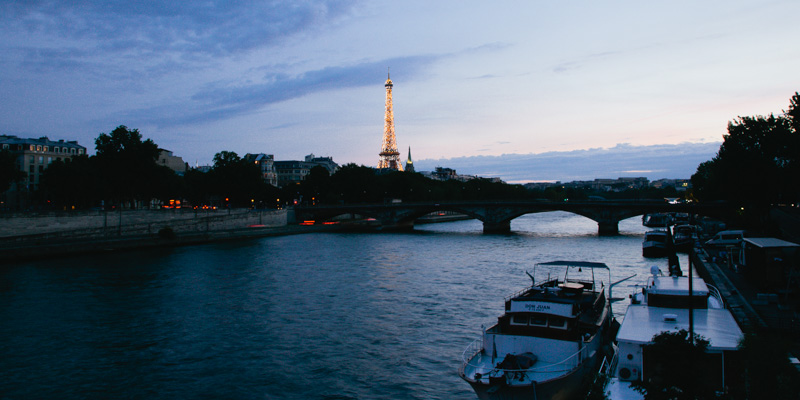
the eiffel tower.
especially when it lights up and sparkles.
and it’s even more amazing than it is during the day.
This happens for the three summer months from dusk to 1am, at the top of every hour for 10 minutes.
The first time I saw this, we were on our Fat Tire Bike Tour riding through the Tuileries garden like we were possessed trying to catch our evening boat tour.
Seriously it was magical. It was probably even more magical because I didn’t know about this little tradition.
Fat Tire Bike Tour – engaging and informative bike tour (we especially enjoyed the evening one) + you get to ride a bike through the city like a local!
Evening boat tour on the Seine – many companies do this.
Ice cream at Berthillon – even if you are not an ice cream fan (although how can anyone not be an ice cream fan?), give it a try.
But most of all, make your own Paris. Go and explore, get lost and you’ll discover things that you’ll love.
And one more time, if you are having a wedding in Paris (or even just thinking about it), email me already! :) I can’t wait until the next time I return.
It’s a little funny to be writing about our wedding day more than a year later (I can’t believe it’s been that long already!) but I like the idea of writing it down anyway and being able to reflect on it as the the years go by. I tried to finish this before we left for Iceland last June, but that just didn’t happen.
In this post I’m going to run through the story of our wedding day, and the previous posts on planning are here, here, here, and here.
Now that I’ve been a bit removed from the process, I’m astonished at how much planning went into it. I remember thinking that I didn’t want to stress about anything when it came to planning the wedding but I did stress about a few things, which was inevitable as I’ve come to learn. But, I always tried to keep the big picture in mind, which was getting married to M.
We arrived in France the week before our wedding day and spent a couple of days in Paris with my Mom. We had a few days in Provence before the wedding and planned activities with our families & friends along with final errands to run for the wedding. Table decor, flowers, hair/makeup trial for my MOH Jess and I, and buying wine! We spent late nights talking, hanging out, getting things done, doing a rehearsal of sorts the night before. We didn’t sleep all that much that week. That’s another thing, you will most likely be quite exhausted the day after your wedding.
On the morning of the wedding, M and I woke up early and he drove to Avignon to pick up my aunt & her family and two of our friends. I opted to get a manicure that morning with Jess, and of course half an hour later, I had already ruined two of them. No time to redo it and it ended up not being a big deal. We spent the rest of the morning setting things up: laying out the table settings, setting up for ceremony, putting lavender into the confetti cones we made the night before, putting up string lights for the evening, setting up the candy table etc. Everyone helped out and we were incredibly thankful for that.
In a perfect world, I would have written my vows & thank-you speech months in advance and worried about the other things later. But I left it until the morning of. The two months leading up to the wedding were so hectic that I didn’t have time to sit down and properly think about it (we also moved the month before the wedding). We had figured out the ceremony plan the week before and had a few readings for our friends to choose from. I had no idea how to write a ceremony, but got some great ideas from A Practical Wedding and ended up basing ours on the civil ceremony we had at Cityhall because we liked it so much. I locked myself in our room for over an hour and finally sat down to write my vows and my speech. And then cried for most of that hour as I wrote. I hadn’t realized how much emotion had been accumulating in me and it wasn’t until I sat down and reflected on the significance of the day, our marriage, all the things that had taken place in the past 8 years of our relationship that led us to that day, our families and friends. It was difficult but I made it through. Then I was glad that I had that “good cry”, because then maybe I’d be able to hold it together for the rest of the day (if you know me, you know I’m a really emotional person. I’m that person who cries at the movies…sometimes during scenes where I’m the only person who gets emotional). I wish I had written vows that were more meaningful or more profound, or funnier. But I’ve come to the conclusion that my vows were just one chapter in our marriage.
We picked up peonies and roses for my bouquet and Jess’ bouquet, as well as for the dinner table, the day before. I had assumed (quite incorrectly) that you should just be able to pick up flowers anywhere in Provence. There were lots of flowers, but they were all in people’s properties. And here comes a funny story. There is a beautiful house besides the main road between the villages. It has an incredible garden with beautiful garden roses. We visited a couple of flower stores but for some reason (I honestly don’t even know what it was now) I wanted to check out more. So I made the suggestion of stopping by the “flower house” and see if the owners would maybe consider selling some of them to us. Bad idea #1. We parked by the side of the road and walked up to the property gate, which was wide open. So we walked in. Bad idea #2. We didn’t see anyone, and looked around the main garden and pool area, still no one. So we rang the doorbell. Two minutes later, a lady in her 50’s and what appeared to be her mother came to the door and asked us very angrily in French what we wanted. Jess explained frantically what we wanted to ask and apologized for us. The lady insisted we should have rang the bell at the gate (we would have, had we seen it. We looked for it on the way out and it was hidden by the gate that was wide open). Jess apologized again and again and of course they weren’t interested in selling any of their flowers either. I think the fact that Jess spoke conversational French (she’s quite fluent actually) boded well for us. We were just thankful that they didn’t come to the door with shot guns. Back to the first flower store we went. It turned out they did have peonies even though we didn’t see any in the morning. 60 Euros later, we had over two dozen peonies and a dozen roses. I put the bouquet together on the morning of the wedding, thanks to a little research and a flower arranging class that I went to with Jess. In hindsight, that probably should have been done the night before, so my advice to other DIY-ers out there is to do as much as you can before the wedding day.
During the planning process, I had entertained the idea of doing my own hair & makeup. But then realized that a) I never do anything with my hair and I’m really quite clueless with that kind of stuff and b) I wear minimum makeup on a daily basis and really wouldn’t know what to do with that either. With those two realizations, came the third and final reason that made the decision for me to hire professionals, which was so that I wouldn’t need to worry about hair & make up the morning of the wedding. I loved my hair and was really glad that I still looked like myself after putting on more makeup than I’m accustomed to.
If you’ve ever been to a wedding before, you know that more often than not they run late. After what felt like forever with the makeup application (although it was nice to just sit in a chair and do nothing after a busy morning), I got in my dress, tied my bouquet together with ribbons and went outside for our First Look. I felt nervous, not nervous about the wedding, but just anxious from anticipation. I talked about our First Look and why I love the idea of it as a photographer, in a separate post here so I won’t mention too much here. I will say again though, that it was one of my favourite moments of the day, to spend with my husband. We had seen each other that morning here and there, but it was so special to spend those quiet moments alone with him after we both got ready. And that was the second time I got teary eyed that day. I remember saying to M that I didn’t really want to have our ceremony in front of everyone, even though they were our closest friends & family. I think the introvert in me just wanted to elope with just the two of us.
We left out a lot of traditions (the ones that didn’t really make sense to us) when it came to the wedding. One of the few we did keep was to have a Chinese tea ceremony with my mom and my aunt as a way of honouring my heritage. The funny thing about a wedding day is the emotions that sneak up on you at unexpected times.
After some family photos, it was time for the ceremony. As I stood linking arms with my mom, and watched Jess walk down the aisle ahead of us to the music of Desiree’s I’m Kissing You, I started to tear up again. And as we walked down towards my groom, I couldn’t help but smile as M beamed at me. No tears there, he was just too happy. My mom gave me the longest squeeze after we reached M…probably one of my favourite photos from the day. A lot of people say that the day goes by in a blur, especially the ceremony. But for me, the ceremony was one of the most memorable parts of the day. We didn’t want to rush it to get to the “party” or just gloss over it because it was only a gesture. For me, the ceremony is the “meat and potatoes” of the wedding, the reason why you are all gathered in one place. After all, you can throw a big party any time.
One of the readings we had was by Victor Hugo, from Les Miserables:
“You can give without loving, but you can never love without giving. The great acts of love are done by those who are habitually performing small acts of kindness. We pardon to the extent that we love. Love is knowing that even when you are alone, you will never be lonely again. And great happiness of life is the conviction that we are loved. Loved for ourselves. And even loved in spite of ourselves.”
The other one was this lovely story by Edward Monkton. :)
In all the small chaos of the morning, we forgot to tell everyone about the lavender cones. But that’s ok, they threw them at us anyway.
Then off we went for some portraits.
Not bad for a bouquet I put together right? in fairness, the peonies were nice & full and so easy to work with.
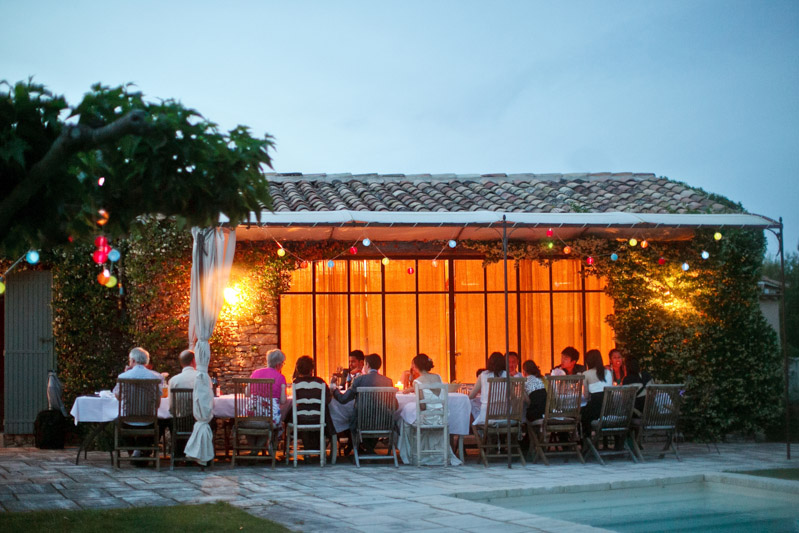
There were some lovely speeches throughout the evening…but I just loved sitting under the evening sky, with the setting sun behind us, enjoying a delicious meal with our friends and family, and listening to some live music.
The Nikonites :D
And of course, some sweet treats since I have a weakness for sweets.
At the end of the night, we said our thank you’s and danced under the stars.
So there you have it: our DIY destination wedding. It certainly wasn’t perfect but it was largely how we had envisioned our wedding day would be. I still can’t believe we pulled it off in the middle of planning a move, working full time jobs, running my own business, without killing each other. That’s gonna count for something right? Here are some closing thoughts on wedding planning:
– Do something that you will absolutely love, whatever it is. A wedding is largely planned for the enjoyment of your guests, but it is also first and foremost, for the two of you. So do what you love.
– It’s so easy to get lost in all the little things that go into a wedding. When you get frustrated by one of those little things, take a step back and ask yourself if you really need that flower that’s out of season, or that particular table linen. Remember why you are doing this in the first place; because the feelings of love and joy, that’s what you will most likely remember 5, 10, 20 years down the road.
– When in doubt, hire a planner! (a good one that is) Why? See part 1 of this series
– Hire vendors you can trust to execute your vision, and trust them to do it. As a photographer, I can’t stress this enough. Sometimes a leap of faith is required, but do your research and trust your gut instincts.
– Don’t be afraid to ask for help…we thought we could do everything for our tiny little wedding, but we still couldn’t. It both felt vulnerable and awesome to have help, especially on the day of. (Yes I definitely have issues when it comes to asking for help)
– Plan, and research and stress if you must, because even if you don’t want to, it will happen. But on the day of, let it all go and just enjoy the day. Pause often and take everything in, commit them to memory…and be thankful that you found a great photographer to help you remember it all afterwards too ;)
– Don’t stop working on your marriage after the wedding. The wedding is one day, but your marriage will be the rest of your life (at least, I hope so).
P.S. all the lovely photos are by the talented Chloé of Caught the Light.
P.P.S. please don’t mind the various grammatical errors..
P.P.P.S. thanks so much for reading! if you are planning a small destination wedding, I hope you’ve found this series helpful. If you are not, I hope you’ve found this entertaining.
And so another year has passed before another Good reads post. I’m more than a little embarrassed that this didn’t happen sooner. Looking back I feel like one of the reasons I failed to read and write more was because I only thought about it vaguely, I thought about it constantly, but vaguely. I read somewhere before that one of the first steps of achieving a goal is to be very specific about it. So for this year, I’m setting a goal to read one book per month. Specific but realistic at the same time I think. I would have liked to read one book per week or something like that but I also know that’s not very realistic given what my schedule will be like in the summer.
I think I read 5 or 6 books this past year but instead of trying to write about each of them (because the first 3 or 4 I had read almost half a year ago), I thought I’d just share some thoughts on my two most recent reads.
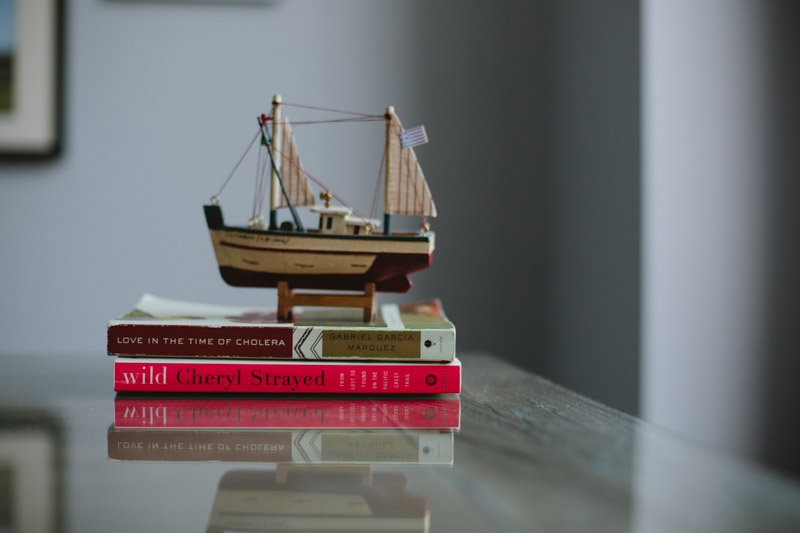
Wild: I had heard of Cheryl Strayed’s memoir while I still worked at my previous job (which almost seems like another lifetime ago now) but at the time I didn’t know too much about it other than it being a memoir from a long-distance hike through the pacific coast from California to Oregon. I’m not really a non-fiction reader because I feel that most of them aren’t done in a storytelling manner so this wasn’t on my list. It wasn’t until a few months ago when I was researching for some quotes that I came across the book again on goodreads.com. I was reading some of the quotes from another one of Cheryl’s books, Tiny Beautiful Things: Advice on Love and Life from Dear Sugar and was so intrigued by her then that I wanted to read Wild right away. I started this before the holidays and just finished it today. The book chronicles her journey of hiking the Pacific Crest Trail from California to Oregon in the span of three months, alone. And what a journey it was. It was a journey in the physical form, but also in the emotional and spiritual form. She embarked on this journey a few years after losing her mother to cancer and a year after divorcing from her husband whom she still deeply loved. It was a deeply moving and inspiring read for me. In the beginning of her journey, the author was battered by the elements, weighed down (both in reality by her monstrous backpack, and metaphorically) but emerged scarred, humbled, yet triumphant and redeemed; having made peace with her demons so to speak: grief, loss, forgiveness. The account of her mother’s sudden and brief battle with cancer, and then her death in the early parts of the book rocked me with a kind of anguish that almost felt real.
Some of the most memorable things for me include when she realized that all the things she needed to survive could be carried on her back, and that she could bear the unbearable (her enormous backpack being the physical metaphor). And as she was out there in the wild, most of the times, all by herself, she learned a simple yet profound fact: how often she had to do the things she wanted to do the least. There weren’t other physical or material distractions to hide behind; no escape, and no denial; and that she often had two choices: to go back in the direction she had come from, or move forward.
Anyway, without giving away too much of the book, here’s one of my favourite passages, about what it feels like to be in the wild:
“It only had to do with how it felt to be in the wild. With what it was like to walk for miles for no reason other than to witness the accumulation of trees and meadows, mountains and deserts, streams and rocks, rivers and grasses, sunrises and sunsets. The experience was powerful and fundamental. It seemed to me that it had always felt like this to be a human in the wild, and as long as the wild existed it would always feel this way.”
Love in the Time of Cholera: This book was highly recommended by a dear friend of mine. When I first started it, I was very intrigued because the author had started the story in what appeared to be the middle. I certainly wanted to continue and get to the bottom of it. When it comes to fiction, I tend to prefer plot driven or character driven stories. This didn’t read like a plot driven story but there were plenty of characters. However, soon I felt like I only knew very little about the characters and they just weren’t developing fast enough for me. I carried on reading though. There was something about the way Mr. Marquez writes (this was the first book by him I’d read) that just flows so beautifully. It reminds me of the voice of melodic narrators in films (as strange as that might sound). He was like the narrator of the movie (500) Days of Summer. So instead of reading the book in a couple of weeks, it took me months to finish it. Though it wasn’t necessarily a bad thing, it just meant that I could put it down and pick it back up again like I hadn’t missed a beat. In the end, it was definitely well worth the time. Having finished it, I felt like I had not read, but rather listened to a story, the way stories were passed down in the beginning of time. It’s about a love story that went through the years, about the choices that one makes without understanding them, what it means to build a marriage and the exploration of love in all its complexity and contradictions. It was also a wonderful portrait of a bygone era and really evokes a sense of feeling for the places in the book.